The Men Without Pulpits: Missouri's Jesuit Brothers and the Ministry of the Steady Hand
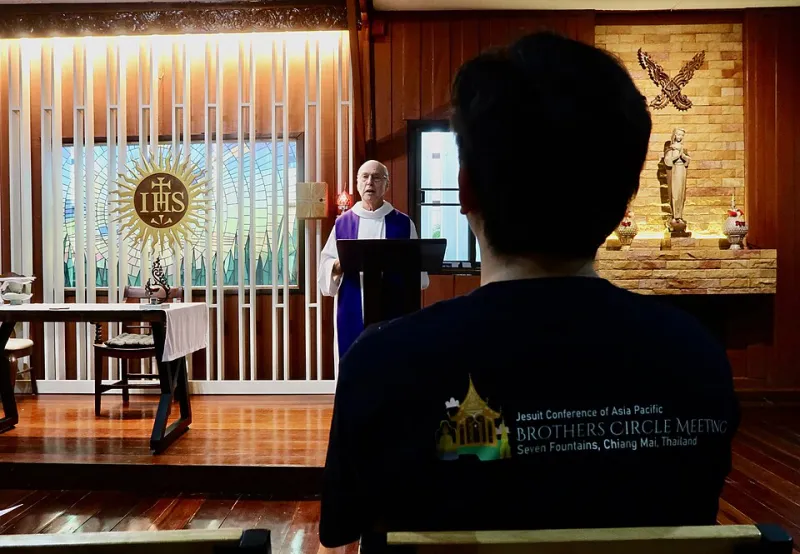
Photo: Bro. Jeffrey Pioquinto, SJ from Dublin, Ireland, Philippines, CC BY 2.0, via Wikimedia Commons
On a Tuesday morning in Kansas City, Brother Vincent sits in a small room at a correctional facility with six men and a worn copy of the Gospels. He is not ordained. He cannot celebrate Mass or hear a confession. What he can do is show up, week after week, with a listening ear and a long memory for names. One man in the group has been out of prison for three years and still calls Brother Vincent when he is tempted to return to old habits. Another asks him to pray for a daughter who will not speak to him.
This is the ministry of the Jesuit brother. It is not centered on a pulpit. It is centered on presence. In Missouri, Jesuit brothers have served for generations as teachers, farmers, cooks, infirmarians, retreat directors, prison ministers, and community organizers. Their vocations are often overlooked in a church that tends to measure ministry by platform and title. Yet their hidden work raises a question that matters for every Catholic community: what does faithful ministry look like when it is not performed in front of a crowd?
A Vocation That Is Not a Lesser Priesthood
Jesuit brothers are members of the Society of Jesus who take vows of poverty, chastity, and obedience but are not ordained. They are not failed priests or替补 clergy. They are men who have discerned a distinct call to religious life and mission. They pray, live in community, and work alongside priests and lay colleagues. Their ministries vary widely: education, healthcare, retreat work, social services, parish administration, agriculture, and the arts.
The history of brother vocations in Missouri is woven into the larger story of the Jesuits in the region. In the nineteenth and early twentieth centuries, brothers often kept institutions running. They managed farms, cooked meals, repaired buildings, and cared for the sick. Some were missionaries; others were skilled tradesmen whose work made the apostolate possible. After the cultural and religious upheavals of the 1960s, vocations to religious life declined across the United States, and the number of brothers shrank. In 2026, the province continues to reexamine how brother vocations are promoted, formed, and understood.
The men who remain are not relics. They are reminders that the church needs many kinds of service. A brother who can fix a boiler or balance a budget or sit with a dying man is not doing secondary work. He is doing the work of the Gospel in a particular key.
Brother Vincent: The Long Ministry of Showing Up
Brother Vincent has worked in prison ministry for more than two decades. He asked that his surname be omitted so that the focus would remain on the men he serves. His week includes Bible study, letter writing, and family visits. He also trains volunteers and advocates for reentry programs.
What strikes him most is not the dramatic conversion story. It is the slow work of trust. Men who have been abandoned by family and institutions learn to believe that someone will return. Brother Vincent returns. He remembers birthdays. He follows up on job applications. He does not pretend that faith solves every problem. He offers the Sacraments to the extent that a brother can: he points people toward priests, encourages confession, and accompanies them to the church door.
His ministry challenges the assumption that spiritual authority is only exercised from a sanctuary. Sometimes it is exercised in a visitation room, a halfway house, or a phone call at 10 p.m.
Brother Charles: Hospitality as a Skill
Near St. Louis, Brother Charles directs retreats and supervises the hospitality team at a Jesuit retreat house. He is a gifted listener, but he is also a competent administrator. He knows how to order food, schedule spiritual directors, and make a stranger feel at home. He describes retreat work as a ministry of atmosphere. People arrive tired and guarded. The brother's task is to create enough safety for them to pray.
Brother Charles is quick to say that lay colleagues do much of the work. His vocation is not a solo performance. It is a way of belonging to a community and offering his particular gifts within it. He worries that young Catholics rarely hear about brotherhood as a real option. They hear about priesthood and marriage. They hear about religious sisters. The brother's vocation can seem invisible.
Brother Andrew: The Steady Presence in the Neighborhood
In north St. Louis, Brother Andrew works with a parish and a neighborhood association on housing and public safety. He is not the pastor. He is not the executive director. He is the person who shows up at meetings, learns names, and keeps a commitment when the novelty has worn off. Community organizing is slow work. It requires patience with bureaucratic delays and human frailty. Brother Andrew describes it as a school of hope.
His presence also challenges the church's fixation on visibility. A brother may never appear in a diocesan newspaper. He may never preach a homily. But he may be the person who helps a block association reopen a park or a family secure a repair loan. This is ministry without a pulpit, and it is indispensable.
What the Brothers Ask of the Church
The brothers interviewed for this article did not ask for applause. They asked for better vocational awareness. They asked that young men be told that brotherhood is a real path, not a consolation prize. They asked that laypeople and priests collaborate with them as equals in mission. And they asked that the church resist the temptation to equate importance with visibility.
In a culture that rewards platform and performance, the Jesuit brother offers a counter-witness. He is a man of vows, community, and work. His ministry is often hidden, but it is not passive. It is the steady hand that keeps a mission alive. Missouri's Jesuit community is richer because of these men, and the wider church would do well to learn from them.