Still Waters at Nightfall: Reclaiming Rest Through the Ignatian Examen in an Age of Anxiety
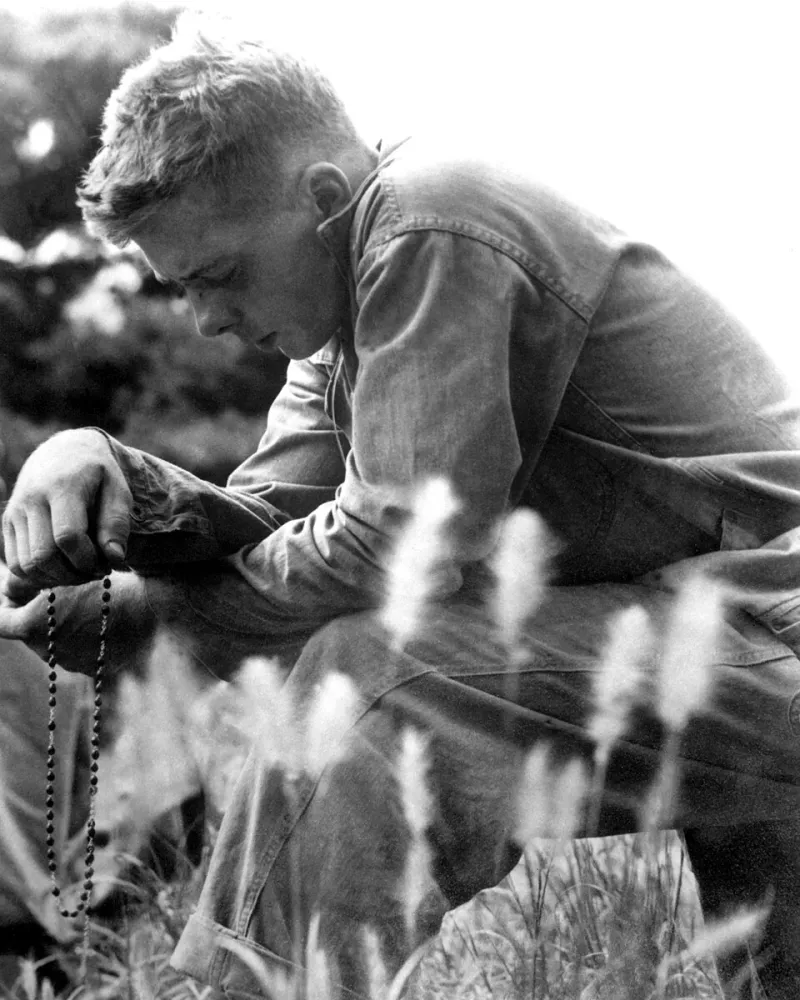
Photo: Corporal Eugene Suarez, Public domain, via Wikimedia Commons
America is exhausted. According to the Centers for Disease Control and Prevention, more than one-third of American adults report regularly failing to obtain the recommended seven hours of sleep per night. Anxiety disorders affect an estimated forty million adults in the United States, and clinicians consistently point to rumination—the habit of mentally replaying the day's frustrations, failures, and fears—as a primary driver of insomnia. Meanwhile, the average American spends more than seven hours each day staring at a screen, a behavior that neuroscientists have linked to elevated cortisol levels, suppressed melatonin production, and a chronic inability to disengage from the cognitive noise of modern life.
Into this landscape steps a practice that predates the smartphone, the industrial revolution, and even the printing press: the Daily Examen of St. Ignatius of Loyola.
A Practice Born in Stillness
Ignatius of Loyola developed the Examen in the sixteenth century as a twice-daily discipline of prayerful self-examination. Far from a moralistic accounting of sins, the Examen is fundamentally an exercise in attentiveness—a structured invitation to review the day's experiences in the presence of God, to notice where one felt drawn toward consolation or pulled toward desolation, and to carry those observations forward with gratitude and renewed intention.
The traditional five movements of the Examen are deceptively simple: give thanks, ask for illuminating grace, review the day with honesty, acknowledge where one fell short, and look ahead to tomorrow with hope. Ignatius considered this practice so essential that he regarded it as the one spiritual discipline a Jesuit should maintain even when illness or extreme circumstance prevented all other forms of prayer. That estimation speaks volumes about the practice's perceived power—not as spiritual luxury, but as interior necessity.
For centuries, the Examen was practiced primarily in religious communities and among those receiving formal spiritual direction. Today, its relevance has expanded dramatically, and Missouri's Jesuit institutions are among those helping to make it accessible to laypeople navigating secular, high-pressure lives.
What Neuroscience Tells Us About Reflective Prayer
Contemporary research in psychology and cognitive neuroscience offers a compelling secular framework for understanding why the Examen works. The practice engages what researchers call the brain's "default mode network"—the neural circuitry associated with self-referential thought, memory consolidation, and meaning-making. When this network is activated in a structured, intentional manner rather than through anxious rumination, it can facilitate what psychologists describe as narrative coherence: the capacity to integrate daily experiences into a meaningful personal story rather than experiencing them as a disorganized flood of stressors.
Dr. Andrew Newberg, a neuroscientist at Thomas Jefferson University who has studied the neurological effects of contemplative prayer extensively, has noted that regular reflective practice can reduce activity in the amygdala—the brain's threat-detection center—while increasing engagement in the prefrontal cortex, which governs measured, deliberate thought. In plain terms, structured evening reflection appears to shift the brain from a state of reactive vigilance toward one of calm integration. This is precisely the neurological environment conducive to restful sleep.
The Examen does not merely rehearse the day's events; it filters them through a lens of divine presence and personal meaning. That theological dimension, far from being incidental, may be central to its efficacy. Research on gratitude practices—which closely parallel the Examen's opening movement—consistently demonstrates reductions in perceived stress, improvements in sleep onset, and enhanced overall well-being among regular practitioners.
Voices from Missouri: Living the Practice
At Saint Louis University, a Jesuit institution with a long tradition of Ignatian formation, campus ministry staff regularly introduce the Examen to students during orientation retreats and first-year formation programs. Many students report that the practice fundamentally alters their relationship with the end of the day.
"Before I learned the Examen, I would get into bed and immediately start replaying everything that went wrong," said one undergraduate student who requested anonymity. "The Examen gave me a structure that didn't ignore the hard parts of the day but placed them in a larger context. I started sleeping better within two weeks."
A laywoman from Kansas City, who has practiced the Examen for nearly a decade after encountering it through a parish Ignatian spirituality program, describes the practice as a form of nightly "defragmentation"—a term she borrows from computing. "My mind was always running too many programs at once. The Examen taught me to close them down one by one, intentionally, rather than just letting them crash."
Jesuit priests and brothers in Missouri also speak of the Examen's particular relevance in the current cultural moment. The relentless pace of digital communication, the blurring of professional and personal boundaries accelerated by remote work, and the ambient anxiety generated by the news cycle have conspired to make genuine interior stillness increasingly rare. The Examen does not promise an escape from these pressures; it offers a nightly return to one's deepest self—and to the God who dwells there.
Adapting the Examen for the Nightly Routine
For those new to the practice, the following framework offers a practical entry point. No special equipment, formal training, or extended time commitment is required. Many practitioners complete the Examen in ten to fifteen minutes, though it may expand naturally as the habit deepens.
Begin with gratitude. Before reviewing the day's difficulties, pause to name three specific moments—however small—for which you feel genuinely thankful. This is not performative optimism; it is a deliberate act of noticing God's presence in the particular.
Ask for clarity. Invite the Holy Spirit, or simply the deepest part of your own conscience, to illuminate the review that follows. This movement guards against the kind of harsh self-judgment that transforms reflection into rumination.
Walk through the day slowly. Move chronologically through the day's significant moments, relationships, and decisions. Notice where you felt most alive, most connected, most authentically yourself. Notice also where you felt contracted, reactive, or distant from your better self.
Acknowledge what needs acknowledgment. Without excessive self-criticism, name the moments where you fell short of your own values or failed to respond with the generosity you intended. Bring these to God not as a prosecutor but as a child returning home.
Look toward tomorrow with intention. Close by naming one specific hope or resolution for the day ahead. This forward-facing movement transforms the Examen from a retrospective exercise into a living practice of ongoing conversion.
Crucially, spiritual directors working within the Ignatian tradition recommend keeping electronic devices outside the bedroom during the Examen, or at minimum setting them to silent and placing them face-down before beginning. The practice is most effective when the mind has been given even a brief period of digital disengagement.
An Ancient Remedy for a Modern Affliction
The sleep crisis and the anxiety epidemic are, at their core, crises of attention—a collective inability to be present to one moment without being simultaneously haunted by a hundred others. The Examen does not resolve this difficulty by force of will. It resolves it by grace: by gently training the practitioner, night after night, to find God in the specific texture of each day rather than in the abstract noise of everything at once.
Missouri's Jesuit community extends an open invitation to anyone weary of lying awake in the dark with an unquiet mind. The Examen asks only for honesty, a few minutes of genuine stillness, and the willingness to believe that the day just lived—with all its imperfections—was worth examining in the presence of a God who was present throughout it.
That belief, practiced faithfully at nightfall, has a remarkable capacity to make the darkness feel less threatening and the morning feel more possible.